
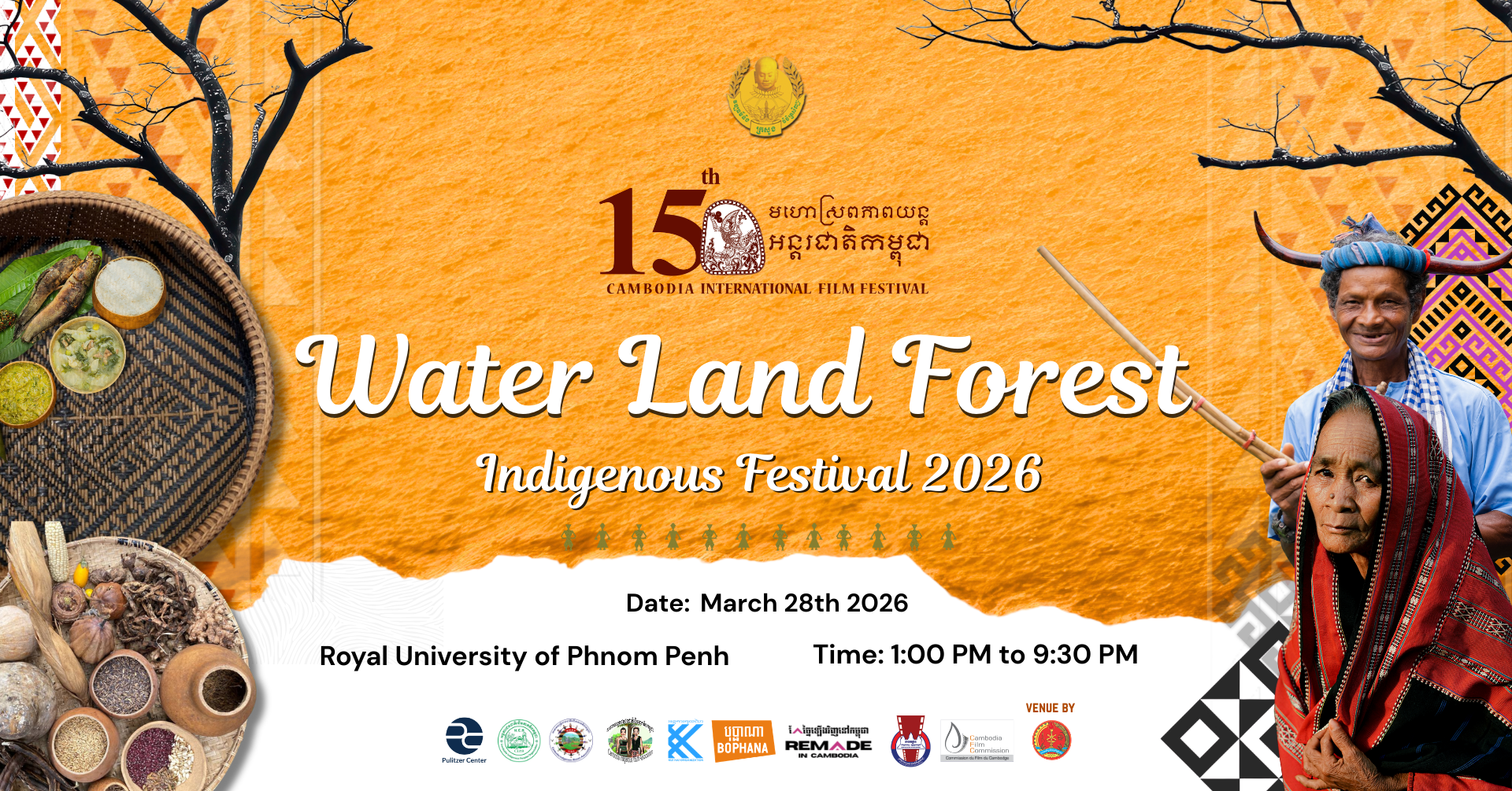
Water Land Forest: Indigenous Festival 2026
- 8:00 am - 9:00 pm
Water Land Forest: Indigenous Festival
Date: Saturday, 28 March 2026 (Time: 1:00 PM – 9:30 PM)
Venue: Royal University of Phnom Penh (RUPP), Phnom Penh, Cambodia
Background
The “Water, Land, Forest Indigenous Festival” is a cultural and public engagement event organized as part of the official program of the 15th Cambodia International Film Festival (CIFF 2026), which will take place on March 28, 2026, at the Royal University of Phnom Penh (RUPP). The festival is a collaborative initiative between Indigenous communities, Indigenous organizations and networks in Cambodia, the Cambodia International Film Festival, and supporting partners. The event aims to create a public platform to showcase Indigenous identity, culture, traditional knowledge systems, and contemporary creativity of Indigenous Peoples.
Based on the theme “Water, Land, and Forest,” the festival highlights the deep relationship between Indigenous Peoples and nature. For Indigenous communities, water is life, land is identity, and forests are home, spirituality, belief systems, and livelihoods. These relationships are not only cultural but also social, environmental, and intergenerational, connecting knowledge, traditions, and ways of life from one generation to another.
At a time when the world is facing climate change, environmental degradation, and the loss of traditional knowledge and cultures, Indigenous knowledge and practices continue to provide important lessons on environmental protection, resilience, and collective well-being. Indigenous Peoples are widely recognized as custodians of forests, natural resources, and cultural heritage, playing a crucial role in protecting the environment and biodiversity.
Globally, there are more than 370 million Indigenous Peoples living in over 90 countries. In Cambodia, there are 22 Indigenous groups with a population of approximately 172,980 people, representing about 1.11% of the total population. These communities live across 15 provinces, including Ratanakiri, Mondulkiri, Kratie, Stung Treng, Preah Vihear, Kampong Thom, Oddar Meanchey, Banteay Meanchey, Tboung Khmum, Pursat, Battambang, Siem Reap, Koh Kong, Kampong Speu, and Preah Sihanouk. Their presence contributes significantly to Cambodia’s cultural diversity, traditions, and national identity.
The “Water, Land, Forest Indigenous Festival” also serves as a public learning space where visitors can explore Indigenous perspectives and ways of life through film screenings, art and handicraft exhibitions, traditional ceremonies, cultural dialogues, music, traditional food, Indigenous fashion, weaving demonstrations, and community storytelling. The festival aims to strengthen public awareness and recognition that Indigenous Peoples are knowledge holders, cultural custodians, and environmental defenders on the frontlines of protecting nature and cultural heritage.
This festival is particularly important because it creates an inclusive platform for Indigenous women, youth, elders, artists, and community representatives to share their voices, experiences, and visions for the future. The event also promotes solidarity and collaboration among communities, organizations, cultural practitioners, educational institutions, and the general public, while encouraging respect, dignity, and deeper understanding between Indigenous Peoples, Khmer communities, and national and international audiences.
Objectives
- To celebrate, promote, and preserve Indigenous cultures, identities, traditions, and knowledge systems related to water, land, and forests.
- To raise public awareness about the values, rights, roles, and contributions of Indigenous Peoples in Cambodia and globally, particularly in environmental protection, cultural preservation, and sustainable development.
- To create a public platform for Indigenous voices, especially Indigenous women and youth, to share stories, experiences, knowledge, and creative expressions of their cultural identity.
- To promote cross-cultural learning, dialogue, and understanding between Indigenous communities, the general public, students, artists, and researchers through interactive activities, films, arts, panel discussions, and exhibitions.
- To strengthen solidarity and collaboration among Indigenous organizations and networks, cultural practitioners, media partners, universities, and development partners working on Indigenous rights, environment, culture, and social development.